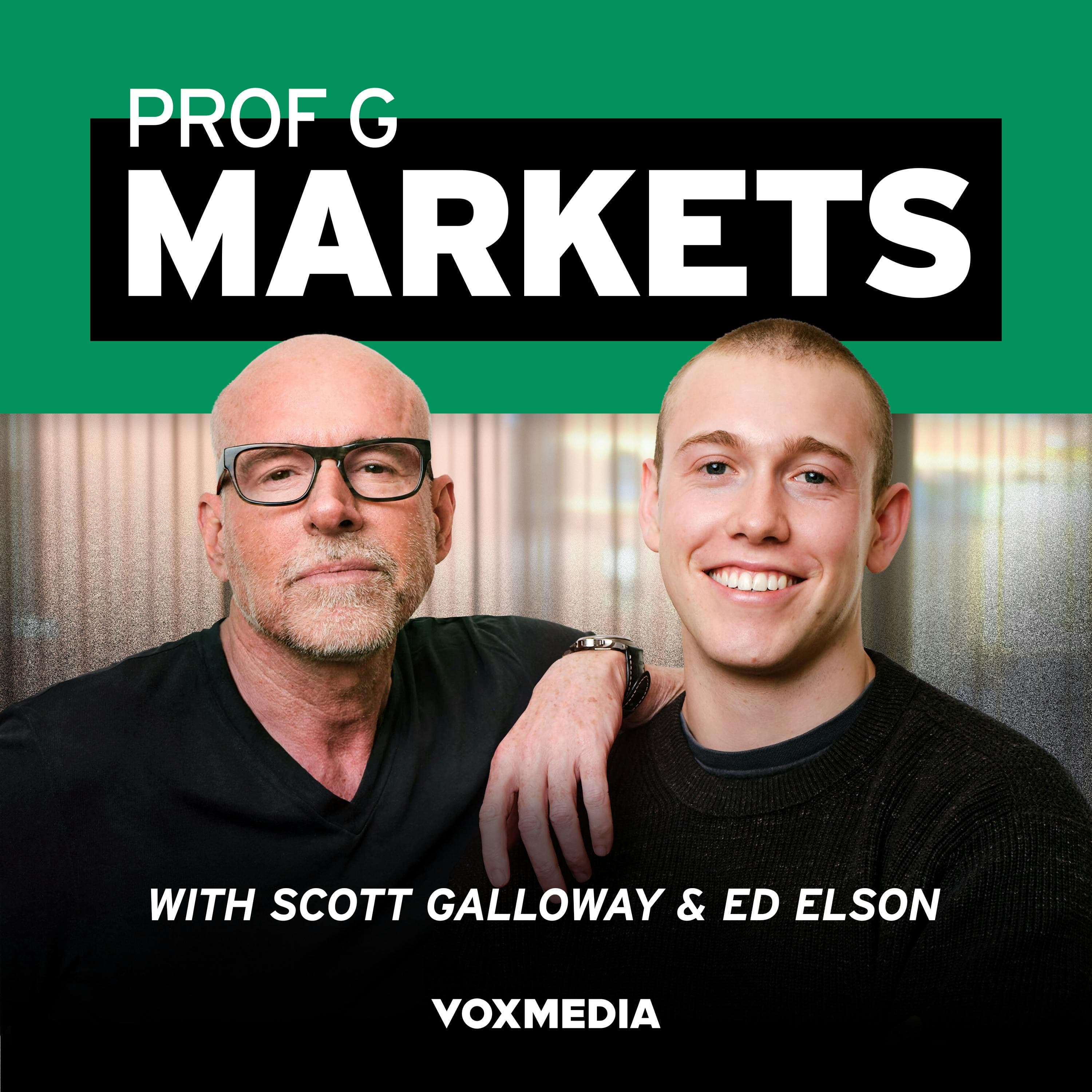
Inside ASML’s Earnings Beat, Netflix’s Podcasting Move & the Largest Data Center Acquisition Ever
Timestamps are as accurate as they can be but may be slightly off. We encourage you to listen to the full context.
Podcast Summary
In this episode of ProfG Markets, host Ed Elson explores AI infrastructure through two major stories. The first half focuses on ASML, the Dutch lithography company that makes the machines essential for chip production, with guest Andrew Gardiner from Citi discussing their impressive earnings that beat expectations. (11:00) The second half examines the disconnect between massive data center investments and actual construction progress, revealing that while investors are pouring billions into data center deals, many projects face significant power grid and construction challenges. (30:00) The episode also covers Netflix's entry into podcasting through exclusive partnerships and a major $40 billion data center acquisition led by NVIDIA, Microsoft, and BlackRock.
- Core theme: The gap between AI infrastructure hype and actual implementation reality
Speakers
Ed Elson
Host of ProfG Markets and a key voice in financial media analysis. Elson specializes in breaking down complex market movements and technology sector developments for professional audiences.
Andrew Gardiner
Head of European Technology Equity Research at Citi with extensive expertise in semiconductor and technology infrastructure markets. Gardiner provides institutional-level analysis on major tech companies and has deep knowledge of the AI supply chain dynamics.
Scott Galloway
Professor, entrepreneur, and media personality who founded several companies and is known for his sharp analysis of technology and business trends. He regularly appears as an expert commentator on major business developments and strategic market moves.
Key Takeaways
Infrastructure Investment Requires Actual Execution Analysis
The episode reveals a critical disconnect between announced AI infrastructure investments and actual construction progress. (30:34) Research shows that of all announced data centers, only 25% are actually under construction, while companies like Jacob Solutions (the leading data center engineering firm) report flat revenue growth over two years. This teaches professionals the importance of looking beyond headlines and press releases to examine actual operational metrics and execution capabilities when evaluating investment opportunities or business partnerships.
Market Timing Beats Market Timing Through Fundamental Analysis
The show's successful prediction of ASML's 35% stock rise demonstrates how fundamental analysis can identify opportunities when market sentiment diverges from underlying business strength. (13:54) In July, when ASML dropped 8% due to tariff concerns, the hosts identified this as a buying opportunity based on the company's essential role in AI infrastructure rather than following market panic. Professionals should develop the discipline to analyze core business fundamentals and competitive positioning rather than reacting to short-term market volatility.
Supply Chain Bottlenecks Create Strategic Opportunities
ASML's situation illustrates how being positioned at critical supply chain chokepoints creates enormous strategic value. (03:08) As Andrew Gardiner explains, ASML essentially has no competition in producing the advanced lithography machines required for cutting-edge chip manufacturing. Understanding and identifying these bottleneck positions in your industry can help professionals position themselves or their companies in indispensable roles that command premium pricing and market power.
Cross-Industry Arbitrage Opportunities Are Expanding
Scott Galloway's analysis of Netflix's podcasting strategy reveals how companies can arbitrage production costs across different media formats. (25:47) He explains that podcasts can achieve 70-80% of TV's production quality at just 10-20% of the cost, while already having built-in audiences. Professionals should look for similar arbitrage opportunities where they can deliver comparable value through more efficient methods or by leveraging existing assets across multiple channels.
Power Grid Constraints Will Define Infrastructure Winners
The episode highlights that grid interconnection requests are 10 times higher than actual data center construction, with electric costs doubling in data center areas. (32:49) This power constraint represents both a massive challenge and opportunity. Professionals working in any infrastructure-dependent business should factor energy availability and costs into their strategic planning, as energy access will increasingly become a competitive differentiator and potential business bottleneck.
Statistics & Facts
- ASML reported €5.4 billion in net bookings for Q3, representing a 105% surge from the previous year, with China accounting for 42% of hardware sales in the quarter, significantly higher than the expected 20-25% range. (03:56)
- Of the approximately 1,500 new data centers announced this year, only 25% are actually under construction, while grid interconnection requests are 10 times higher than the number of data centers being built. (30:34)
- Netflix's podcast arbitrage strategy shows that quality podcast content can be produced at 10-20% of traditional TV costs while achieving 70-80% of TV's production quality, with podcast ad revenue growing 18% compared to 13% for Alphabet and 16% for Meta. (21:58)



