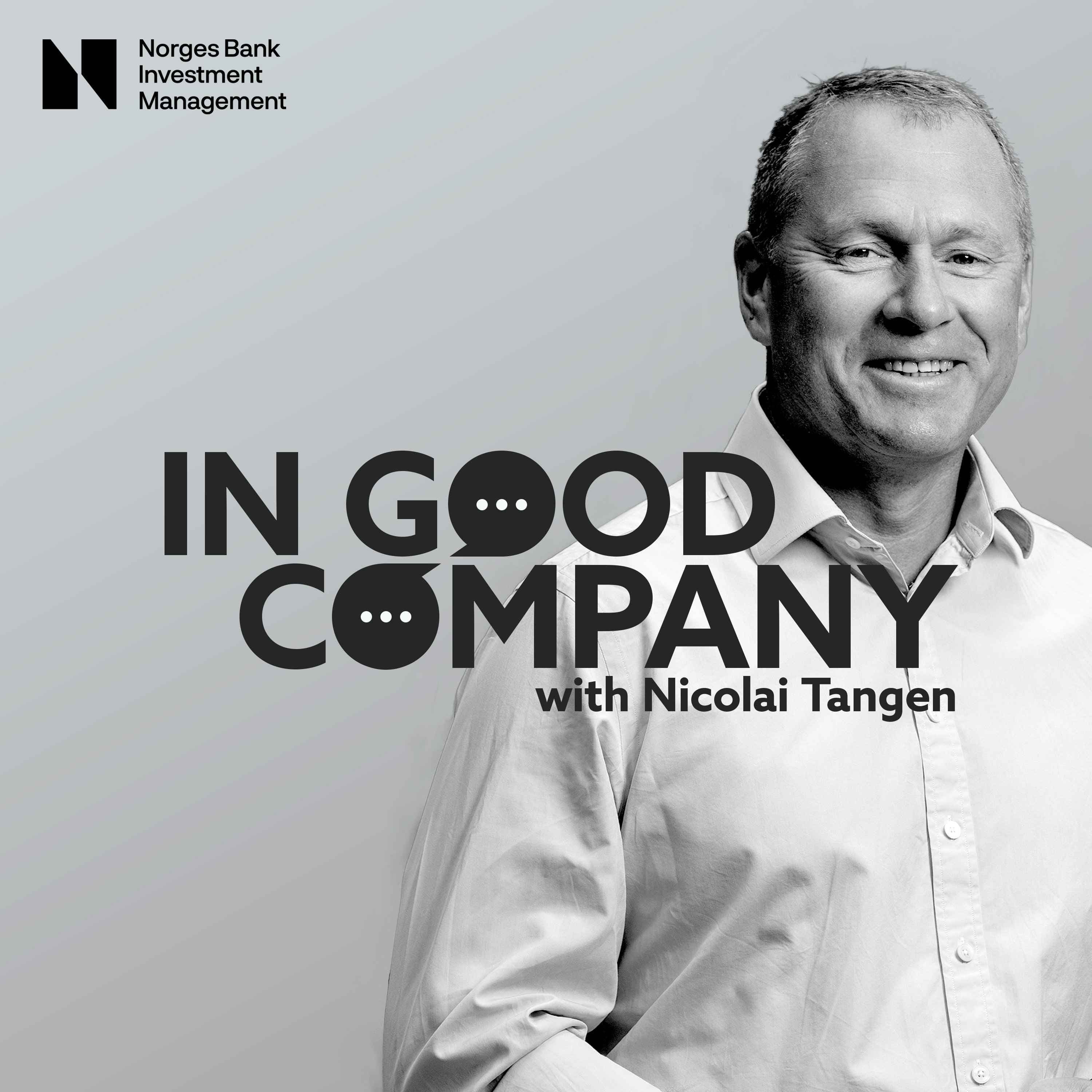
Saul Perlmutter: The Accelerating Universe, Doubt as a Superpower and the Science of Collaboration
Timestamps are as accurate as they can be but may be slightly off. We encourage you to listen to the full context.
Podcast Summary
This episode features a fascinating conversation between Nikolay Tangen, CEO of the Norwegian sovereign wealth fund, and Nobel Prize-winning physicist Saul Perlmutter. (00:22) Perlmutter, who discovered that the universe expands at an increasingly rapid pace, discusses his book "Third Millennium Thinking," which explores how scientific methods can help navigate our uncertain world. (00:50) The conversation delves into the paradox of our times: humanity now possesses the knowledge to solve planetary-scale problems like climate change, pandemics, and global hunger, yet struggles with the fundamental challenge of productive communication and collaboration. (02:35) Perlmutter argues that mastering scientific thinking approaches—including probabilistic reasoning, individual humility paired with collective confidence, and structured disagreement—could unlock our ability to tackle these massive challenges together.
- Core themes include scientific methodology as a framework for decision-making, the balance between individual humility and collective arrogance in problem-solving, and practical approaches for productive collaboration in uncertain environments.
Speakers
Nikolay Tangen
CEO of the Norwegian sovereign wealth fund, one of the world's largest investment funds. Tangen has a background in social psychology and completed his dissertation on gut feel in investing, bringing a unique perspective to financial decision-making and behavioral analysis.
Saul Perlmutter
Nobel Prize-winning physicist who discovered that the universe expands at an increasingly rapid pace, fundamentally changing our understanding of cosmology. He is the author of "Third Millennium Thinking" and teaches at UC Berkeley, where he has developed courses on critical thinking and scientific methodology that have been adopted by multiple universities including Harvard, University of Chicago, and Columbia.
Key Takeaways
Embrace Probabilistic Thinking Over Binary Decisions
Rather than viewing situations as absolutely true or false, Perlmutter advocates for thinking probabilistically—assigning confidence levels to different outcomes. (03:55) This approach makes us more powerful decision-makers because we can differentiate between things we'd "bet our lives on being true" versus those we're only 70% confident about. (04:14) In practical terms, this means approaching arguments with the mindset "I'm 75% sure I'm right, but there's a 25% chance I'm wrong," which creates more fluid discussions and prevents us from becoming overly attached to our positions. This probabilistic approach transforms daily decisions from health care choices to street-crossing into more nuanced, effective judgments.
Balance Individual Humility with Collective Arrogance
Perlmutter describes the scientific superpower as maintaining "individual humility and collective arrogance"—constantly questioning your own assumptions while maintaining confidence that difficult problems can be solved. (05:55) About 95% of an experimental scientist's life involves looking for mistakes, yet this apparent weakness becomes a strength when combined with the "can-do" spirit that allows teams to persist through challenging problems. (10:49) This balance requires being humble enough to accept criticism while maintaining enough confidence to stay with problems long enough to solve them—what Perlmutter calls having both "brakes" (skepticism) and an "accelerator pedal" (determination).
Seek Productive Disagreement Through Structured Processes
The most valuable insights come from engaging with people who disagree with you, but this requires intentional structure to be productive. (07:24) Perlmutter emphasizes that when groups communicate and think through problems together, they almost invariably discover they share the same big goals—differences usually lie in factual questions rather than fundamental priorities. (08:35) To harvest this benefit, organizations should encourage friendly competition where people try to find flaws in each other's thinking, making disagreement a valued part of the process rather than something to avoid. This approach transforms potential conflict into collaborative problem-solving.
Use Blind Analysis to Combat Confirmation Bias
Confirmation bias leads us to accept information that confirms our beliefs while scrutinizing information that challenges them. (17:37) The physics community has developed "blind analysis" as a solution—researchers examine their methodology for errors without seeing the final results, only "unblinding" the data after agreeing they've checked for all possible mistakes. (18:51) This creates dramatic moments where years of work culminate in opening an envelope to see if the hypothesis was correct. (19:25) The principle applies beyond science: when making important decisions, choose your information sources before knowing what they'll say about your specific situation, similar to choosing a trusted medical website before researching your particular symptoms.
Leverage Team Diversity While Managing Information Flow
Effective teams combine people with diverse skills who aren't so ego-driven that they can't collaborate and "enjoy team nature." (12:31) However, when gathering input from diverse team members, collect information independently first to avoid groupthink. (23:33) As Perlmutter explains in the investment example, having people share ideas sequentially creates "herd thinking" because later speakers are influenced by earlier ones and don't want to sound like they're arguing. (23:41) Instead, gather all perspectives in writing independently, then bring people together to synthesize and debate the collected insights. This approach captures the value of diversity while avoiding the pitfalls of social conformity.
Statistics & Facts
- Nobel Prizes are increasingly won by teams rather than individuals, reflecting the collaborative nature of modern scientific discovery. (13:23) Perlmutter notes that even "smallish" projects now involve around 30 people, while current versions of similar projects involve hundreds of researchers working together.
- In the past 25 years, an estimated new theoretical paper about dark energy has been published every 24 hours on average. (49:52) This demonstrates the explosion of theoretical work attempting to understand this mysterious force driving the universe's accelerating expansion.
- Perlmutter's Nobel Prize-winning discovery took 11 years from initial proposal to publication, starting in 1987 and concluding with results in 1998. (50:46) The team initially expected to complete the project in three years but had zero usable supernovae after three years and only achieved their first well-measured supernova after five years.



